

£35.00
Building Safety Act Training
Understanding the Building Safety Act 2022: Roles, Responsibilities & Reform
The Building Safety Act 2022 represents a major reform of the way building safety is regulated, managed and understood.
It was introduced following Dame Judith Hackitt’s Independent Review of Building Regulations and Fire Safety and is intended to create greater accountability, clearer responsibilities and stronger oversight across the built environment. The Act also established the framework for the Building Safety Regulator and introduced a more stringent regime for higher-risk buildings.
For contractors, designers, site managers, project managers, architects, engineers and health and safety professionals, understanding these changes is increasingly important. The legislation affects responsibilities across the design, construction and occupation of buildings, with particular requirements applying to higher-risk buildings.
That is why SAMS LTD is introducing a new Building Safety Act training course designed to make this substantial piece of legislation easier to understand.
Rather than expecting learners to interpret complex legislation themselves, Understanding the Building Safety Act 2022: Roles, Responsibilities & Reform provides practical awareness through realistic workplace scenarios, interactive activities, knowledge checks and examples. The course explores why reform was necessary, who the legislation affects, duty holder responsibilities, competence, the Golden Thread of information and the wider changes introduced by the Act.
If you have been asking what is the Building Safety Act 2022, what it means for your role or how you can improve your understanding of Building Safety Act compliance, this new online course provides an accessible starting point.
1. Course overview
Understanding the Building Safety Act 2022: Roles, Responsibilities & Reform
Designed for construction and design professionals, this interactive, scenario-based eLearning course provides practical awareness of the Building Safety Act 2022 and its impact on organisations and individuals working within the built environment.
The Act is far-reaching. Among other reforms, it established the Building Safety Regulator and introduced new regulatory arrangements relating to building control and higher-risk buildings. Its broader purpose is to strengthen accountability and improve building safety standards.
For professionals working within construction and design, however, knowing that the legislation exists is very different from understanding what it means in practice.
Our Building Safety Act awareness training has therefore been developed to make the subject accessible and relevant. Rather than simply presenting legislation, the course uses realistic workplace scenarios, knowledge checks, interactive activities and practical examples to keep learners engaged while helping them understand how the Act applies in real-world situations.
Learners explore why the legislation was introduced, who it applies to, key duty holder responsibilities, Building Safety Act competence requirements and wider regulatory reform before completing a final knowledge check and receiving a digital certificate.
This makes the course suitable for individuals looking for a practical Building Safety Act 2022 summary as well as organisations seeking to strengthen awareness among relevant employees.
2. Course details
Our Building Safety Act course has been designed around the realities of modern working life. Professionals within construction, architecture, engineering and health and safety often need to fit training around demanding projects and existing responsibilities, so flexibility is an important part of the programme.
The course is delivered entirely online as self-paced eLearning. Learners can progress through the material at a time and location that suits them rather than having to attend a scheduled classroom session.
The programme takes approximately 90 minutes and provides 1.5 hours of CPD-certified learning (2 credits). Progress is saved automatically, and learners receive 12 months’ access, allowing them to return to the material during their access period.
- Delivery: Online, self-paced eLearning
- Duration: Approximately 90 minutes
- Assessment: Final knowledge check
- Certificate: Digital certificate issued on successful completion
- CPD: 1.5 hours CPD certified (2 credits)
- Access: 12 months
- Devices: Desktop, tablet and mobile compatible
For organisations considering Building Safety Act training courses for employees, this flexible format can make it easier to provide awareness training without taking people away from projects for an entire day.
3. Who should complete this course?
The Building Safety Act 2022 has implications for a wide range of people working within the built environment, making awareness relevant beyond any single job title.
The course is particularly suited to construction and design professionals who need a better understanding of the legislation, its reforms and the responsibilities associated with it. It may also be useful for people whose roles bring them into contact with higher-risk buildings or those who need a broader understanding of the regulatory environment surrounding building safety.
Government guidance confirms, for example, that clients, principal designers and principal contractors have legal duties in relation to projects involving higher-risk buildings. Competence is also a significant feature of the strengthened building safety regime.
This Building Safety Act 2022 training is therefore designed to help a broad range of built-environment professionals develop awareness of the principles they may encounter through their work.
Perfect for:
- Contractors
- Principal Contractors
- Principal Designers
- Site Managers
- Project Managers
- Construction Managers
- Engineers
- Health & Safety Professionals
- Architects
- Designers
- Anyone working on or around Higher-Risk Buildings
These audiences are taken directly from the course specification.
4. Learning outcomes
A good Building Safety Act training course should do more than tell learners that legislation has changed. It should help them understand the reasons behind those changes and recognise how the principles relate to roles and responsibilities within the built environment.
The SAMS course has therefore been structured around clear learning outcomes. By the end of the programme, learners should have developed a stronger understanding of why the Act was introduced, when it applies, the concept of higher-risk buildings and the responsibilities of key duty holders.
The course also introduces the importance of competence and the Golden Thread of information. Government guidance describes the Golden Thread as the digital information that relevant duty holders and accountable persons need to retain to support compliance and manage building safety.
By the end of this course, learners will be able to:
- Explain why the Building Safety Act 2022 was introduced.
- Identify when the Act applies and what constitutes a Higher-Risk Building.
- Understand the responsibilities of key duty holders.
- Recognise competence requirements for individuals and organisations.
- Explain the importance of the Golden Thread of information.
- Understand the wider reforms introduced by the Act.
- These are the specified learning outcomes for the new course.
5. Course modules
The Building Safety Act 2022 is substantial legislation, and simply attempting to absorb it as one large subject can make the requirements difficult to understand.
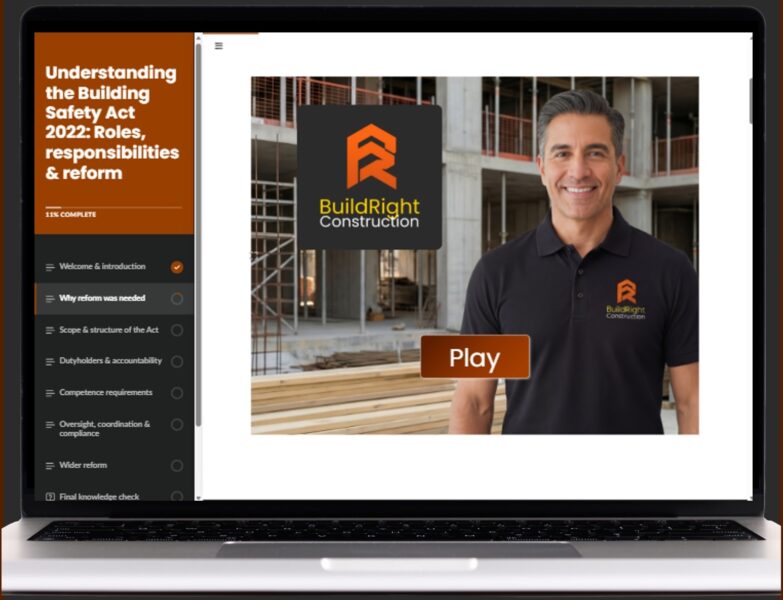
Our course divides the subject into a logical sequence of modules, allowing learners to build their knowledge progressively. It starts by considering why reform was required before moving into scope, structure, accountability, competence, coordination, compliance and wider reform.
This is particularly useful for anyone searching for the Building Safety Act 2022 explained in a practical format. Rather than treating individual requirements in isolation, the course helps learners see how different aspects of the new building safety regime fit together.
The course modules are:
- Welcome
- Module 1 – Why reform was needed
- Module 2 – Scope and structure
- Module 3 – Duty holders and accountability
- Module 4 – Competence requirements
- Module 5 – Oversight, coordination and compliance
- Module 6 – Wider reform
- Final knowledge check
- Course summary
The complete module structure is set out in the course specification.
Why Reform Was Needed
Understanding why the legislation was introduced provides essential context for understanding the requirements themselves.
The Building Safety Act takes forward the Government’s commitment to fundamental reform of the building safety system following Dame Judith Hackitt’s Independent Review. The reforms are intended to improve accountability, oversight and standards within the built environment.
Scope and Structure
The Building Safety Act 2022 requirements are not identical for every building, project, organisation or individual.
Understanding scope is therefore essential. Learners need to recognise where different parts of the regime apply and why the definition of a Building Safety Act 2022 relevant building, particularly a higher-risk building, matters.
For design and construction purposes, current government guidance describes a higher-risk building as one that is at least 18 metres high or has at least seven storeys, and has at least two residential units or is a hospital or care home. The precise legal criteria and exclusions need to be considered for the circumstances concerned.
Duty Holders and Accountability
Accountability is a central theme running through building safety reform.
The course introduces key duty holder responsibilities and helps learners understand that safety needs to be considered throughout the building lifecycle rather than treated as the responsibility of one individual at one stage.
Competence Requirements
Building Safety Act competence is another important part of the changing regulatory landscape.
The Building Safety Regulator has a role in improving competence across the built environment, and the strengthened regime places greater emphasis on people and organisations having the skills, knowledge, experience and behaviours appropriate to the work they undertake.
The course helps learners recognise the importance of competence and understand why simply occupying a particular role is not, on its own, enough.
Oversight, Coordination and Compliance
Successful Building Safety Act compliance relies upon people understanding their responsibilities and coordinating effectively.
Projects involve numerous organisations and professionals. Designers, contractors, managers and other specialists need to understand how their responsibilities interact rather than working in isolation.
This section helps learners consider the importance of oversight, coordination, accountability and compliance within the new regulatory environment.
Wider Reform
Although higher-risk buildings are an important part of the legislation, the Building Safety Act represents wider reform of the building safety system.
The Act includes six Parts and eleven Schedules and makes changes to existing legislation, most notably the Building Act 1984. It also provides for wider measures relating to areas such as architects, construction products, remediation and redress.
The course therefore helps learners develop broader awareness rather than assuming that the legislation can be reduced to a single requirement.
6. What’s included
Our new Building Safety Act training has been designed to make learning engaging and accessible rather than presenting delegates with long sections of legislative text.
Scenario-based learning helps connect the principles of the Act to situations professionals may recognise from the workplace. Knowledge checks throughout the programme allow learners to test their understanding before completing the final assessment.
Automatic progress saving and mobile-friendly access also mean the programme can be fitted around existing commitments.
The course includes:
- Interactive scenario-based learning
- Knowledge checks throughout
- Final assessment
- Digital certificate
- Automatic progress saving
- Mobile-friendly learning
- 12 months’ access
- Technical support from Emblem Training Solutions
These features form part of the supplied course specification.
For businesses looking at Building Safety Act courses for multiple members of staff, online delivery can also provide a straightforward way of increasing awareness across different roles and locations.
7. Technical requirements
Because this is an online, self-paced Building Safety Act training course, learners need access to the internet and a suitable device.
The course has deliberately been designed to work across common devices, meaning learners don’t necessarily need specialist equipment or software to participate.
Before starting, it is sensible to ensure that you have a reliable internet connection and an up-to-date browser. This will help provide a smoother learning experience when completing the interactive activities and final knowledge check.
Technical requirements are:
- Modern web browser
- Internet connection
- Chrome, Edge, Safari or Firefox recommended
- Compatible with desktop, tablet and mobile devices
These requirements are specified by the course provider.
8. Important information
It is important to understand exactly what this Building Safety Act awareness training is designed to provide.
The course provides general awareness of the Building Safety Act 2022. It supports learners in understanding key principles, responsibilities and legislative changes, but it is not intended to replace role-specific professional advice.
This distinction matters because the Act and the wider regulatory framework are complex. How a requirement applies can depend upon factors including the type of building, the work being undertaken, the role of the organisation or individual and the stage in the building lifecycle.
The official course information therefore states:
This course is designed to provide general awareness of the Building Safety Act 2022 and supports learners in understanding the key principles, responsibilities and legislative changes introduced by the Act.
It is not intended to provide legal advice, professional consultancy or formal legal interpretation of the legislation. Learners and organisations should seek appropriate professional advice where specific legal, technical or compliance matters arise.
While every effort has been made to ensure the information is accurate at the time of publication, legislation, guidance and industry best practice may change over time. Emblem Training Solutions reserves the right to update course content where necessary to reflect significant legislative or regulatory changes.
This is particularly important when searching online for Building Safety Act 2022 guidance or Building Safety Act 2022 guidelines. Awareness training can help you understand the overall framework, but specific compliance decisions should be based on the legislation, current official guidance and appropriate professional expertise.
9. Customer terms (for delivery partners)
As an online course, learner access is provided through an individual licence. Customers should therefore understand the conditions relating to accessing the course before beginning their training.
Once learner access has been issued and the course has been accessed, the licence is considered used and becomes non-refundable. Where a refund request is made before access, Emblem Training Solutions can confirm whether the learner licence has been used to assist the Authorised Delivery Partner with its decision.
The supplied course information states:
Online Training Courses
Once learner access has been issued and the course has been accessed, the learner licence is deemed to have been used and is non-refundable.
If a refund request is received before the course has been accessed, Emblem Training Solutions can confirm whether learner access has been used to assist with your decision.
As the contract of sale exists between the customer and the Authorised Delivery Partner, all refund decisions remain at the Delivery Partner’s discretion and should be reflected within their own Terms & Conditions.
Understand the Building Safety Act 2022 with SAMS LTD
The Building Safety Act 2022 has reshaped the regulatory environment surrounding building safety and reinforced the importance of accountability, competence, accurate information and clearly understood responsibilities.
For professionals working in construction, design, engineering, architecture and health and safety, developing an understanding of these reforms is increasingly important.
The new Understanding the Building Safety Act 2022: Roles, Responsibilities & Reform course from SAMS LTD provides an accessible way to build that awareness.
In approximately 90 minutes, learners can work through interactive, scenario-based eLearning covering the reasons for reform, scope of the legislation, duty holders, accountability, competence, oversight, compliance and wider changes before completing a final knowledge check and receiving a digital certificate.
Whether you are a contractor, principal contractor, principal designer, site manager, project manager, construction manager, engineer, health and safety professional, architect, designer or someone working on or around higher-risk buildings, our Building Safety Act course can help you develop a clearer understanding of one of the most significant changes to building safety regulation in recent years.
Build your knowledge, understand the reforms and improve your awareness of the Building Safety Act 2022 with SAMS LTD.
Download Our Building Safety Act Training Overview Guide
Book Your Building Safety Act Training Course Today
Limited places available on upcoming dates.
Email: info@samsltd.co.uk or via our Contact page
Call: 01843 821406
| SSSTS Zoom (2 day WEEKEND SATURDAY & SUNDAY)) | |||
|---|---|---|---|
| Date | Time | Remaining Capacity | |
| SSSTS Zoom (over 2 consecutive Saturdays 29th Nov & 6th Nov) | |||
| Date | Time | Remaining Capacity | |
| SSSTS Zoom (2 consecutive days course) | |||
| Date | Time | Remaining Capacity | |
| January 12, 2026 | 08:45 | 5 | |
| January 19, 2026 | 08:45 | 8 | |
| January 26, 2026 | 08:45 | 10 | |
| February 02, 2026 | 08:45 | 11 | |
| February 09, 2026 | 08:45 | 11 | |
| February 16, 2026 | 08:45 | 12 | |
| February 23, 2026 | 08:45 | 12 | |
| March 02, 2026 | 08:45 | 12 | |
| March 09, 2026 | 08:45 | 12 | |
| March 16, 2026 | 08:45 | 12 | |
Related products
-
UKATA Asbestos Awareness Online Course
Discounts Available- 2+ items, 16% off
- 21+ items, 27% off
- 51+ items, 50% off
- 100+ items, 61% off
-
Level 1 in Food Safety for Catering Video Course
-
Working in Confined Spaces Video Course
-
Abrasive Wheels Video Course